Introduction to Sets
A set is a well-defined collection of distinct objects. Well-defined means we can clearly decide whether an object belongs to the set or not.
Examples include:
- Set of prime numbers less than 10:
{2, 3, 5, 7} - Set of letters in the word "NEPAL":
{N, E, P, A, L} - Natural numbers:
N = {1,2,3,...}
We will study operations on sets, cardinality, exercises, and quizzes in this unit.
Examples from Daily Life| Real-world Group | Set Representation |
|---|---|
| Students in a football team | F = {Hari, Shyam, Ram, Jivan, Priyanka} |
| Students in a basketball team | B = {Ivan, Bella, Sameer, Jivan} |
| Days of the week | D = {Sunday, Monday, Tuesday, ..., Saturday} |
| Vowels in English | V = {a, e, i, o, u} |
| Term | Meaning |
|---|---|
| Element | An individual object in a set |
| Set | A group of well-defined elements |
| Subset | A set whose elements are all contained in another set |
| Universal | Set The set that contains all elements under discussion |
| Venn Diagram | A visual way to show sets and their relationships using closed shapes |
Subsets
A subset is a set whose elements are all contained within another set. If every element of set is also in set , then is a subset of (written as ).
Example: Let
Possible subsets of include:
-
(the empty set)
-
, ,
-
, ,
-
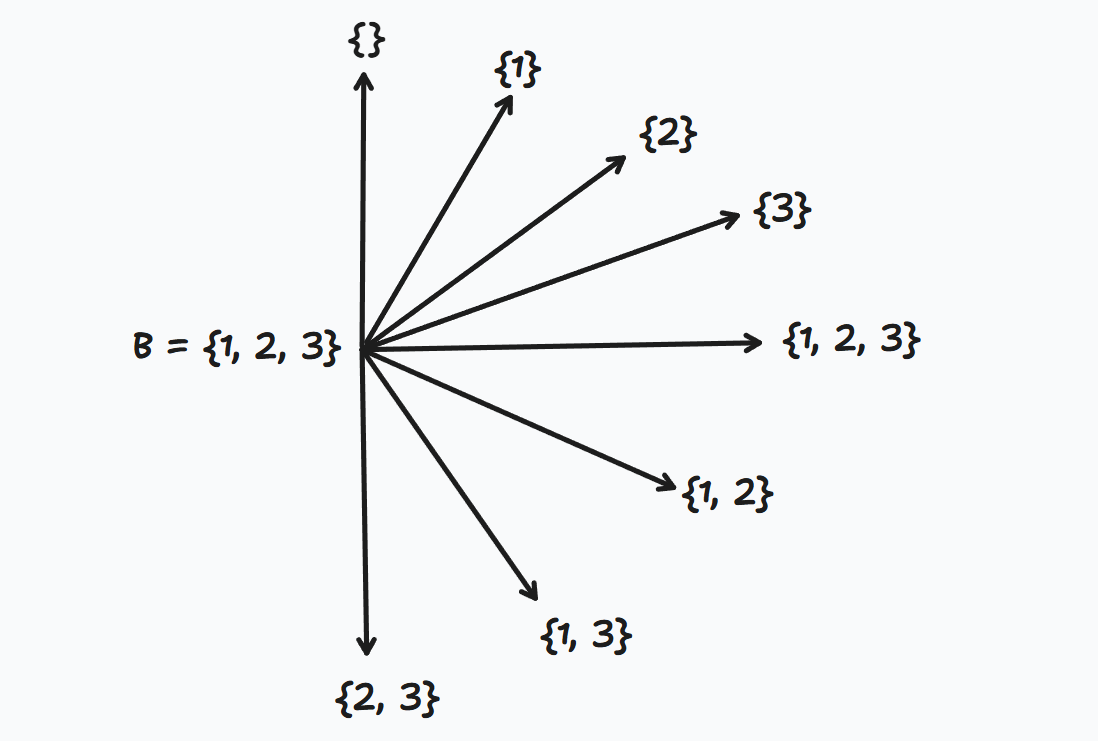
Types of Subsets
1. Proper Subset
A proper subset of is a subset that is not equal to itself.
Notation:
Example:
is a proper subset of .
2. Improper Subset
An improper subset is the set itself.
is an improper subset of .
3. Empty Set (Null Subset)
The empty set () is a subset of every set.
Counting Subsets
If a set has elements, the total number of subsets is (including the empty set and the set itself).
Example:
For ():
- Total subsets:
List of all subsets:
Proper subsets exclude the set itself:
For , proper subsets:
Disjoint Sets
Two sets are disjoint if they have no elements in common.
Formally, sets and are disjoint if or .
Impact on Set Operations
- Intersection: For disjoint sets, .
- Union: The union simply combines all elements: contains all elements from both sets.
- Cardinality: If and are disjoint, .
Real-world Examples
| Scenario | Set | Set | Disjoint? |
|---|---|---|---|
| Boys and girls in a class | Ravi, Sam | Priya, Sita | Yes |
| Prime numbers and even numbers | 2, 3, 5, 7 | 2, 4, 6, 8 | No |
| Students in football vs chess | Ivan, Bella | Samir, Pratyusha | Yes |
is both prime and even, so these sets are not disjoint.
Formula
If and are disjoint:
If not disjoint:
Disjoint sets are important in probability, counting, and organizing groups with no overlap.